
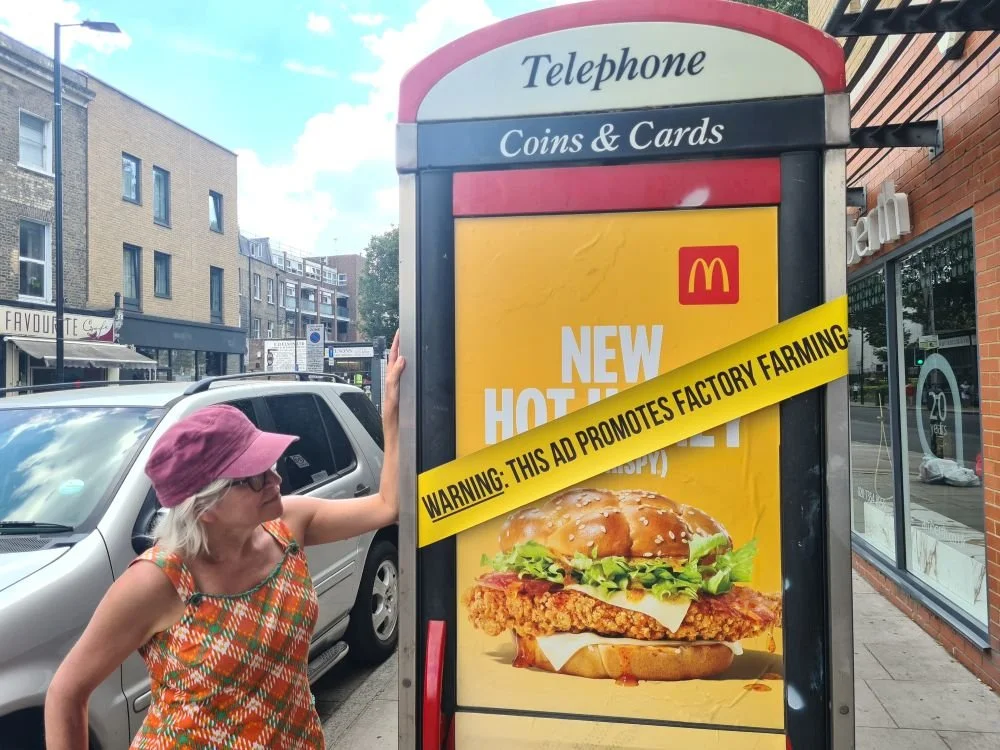
Factory farming hides on our streets, behind billboards advertising big brands like McDonald’s, Greggs or Pret. Adverts are influencing our choices every day, and most of the ads on our streets are for mega-brands which are undermining local businesses, through selling products which are harming the climate, nature, animals – and us. Taking away Big Ag’s ads will remove this pressure, and limit the influence of a powerful and harmful industry – much like removing tobacco advertising did.
That’s why Amsterdam, Haarlem and more cities in the Netherlands have banned meat advertising. They do not want their public spaces used to promote brands which are driving climate breakdown. Hackney has pledged to do the same - which will make them the first UK council to do so.
Will your council be next?
Here is a template letter you can use to write to your councillor(s) to take action against adverts which promote the products of factory farming.
Please:
Find your local councillor’s contact details on your local council’s website or at www.writetothem.com/
Copy and personalise the letter below.
Add your councillor’s name.
Add your own name, address and postcode (this is important so that they know you live in their ward).
Check through the letter, edit and add your own thoughts about why this is important to you.
Let us know if you get a reply! (Email: hello@adfreecities.org.uk)
______________________
Subject: Please take action against factory farming adverts
Dear Councillor,
I am writing to you to ask if the council will take action locally against adverts which promote the products of factory farming.
Like most people in the UK, I am opposed to factory farming, due to this industry’s negative impact on farmers, our environment, our health and animal welfare. I do not want to buy products which support factory farming, if I can avoid it.
However, factory-farmed products are commonly promoted on billboard and bus stop adverts; for example, ads for KFC, McDonald’s, Greggs and Subway. These adverts are driving demand for industrially farmed meat and dairy while keeping the products’ origins a secret. Adverts never show the conditions in which the animals were kept, how the food was made or what the impacts are on the environment or public health.
Furthermore, the adverts in our streets promote multinational meat and dairy businesses, never adverts for locally produced food. I do not want public space in our neighbourhood to be used for promoting products and brands which are undermining local, sustainable food producers and traders. By removing these adverts, we can shift demand and power back to local, sustainable businesses.
Many councils in the UK are taking steps to restrict advertising that is driving climate breakdown and causing harms to our health and to nature. Several municipalities in the Netherlands have banned meat advertising in line with their climate commitments, and the current Hackney administration has recently become the first in the UK to commit to banning meat advertising on council-controlled sites.
Will you use your powers as a councillor to end advertising which is promoting food from factory farming?
Further evidence:
● Globally animal agriculture is responsible for up to 19.6% of global greenhouse gas emissions.[1]
● Over 85% of animals farmed in the UK are confined in intensive farming systems[2] (“factory farms”), designed to maximise production and profit while causing antibiotic resistance and river pollution, as well as subjecting animals to cruel treatment, painful procedures and psychological harm.
● The Climate Change Committee (CCC)[3] and health initiatives including the EAT-Lancet Commission[4] have urged the UK government to support dietary shifts towards eating less meat and more plant-based alternatives.
● Evidence following the ban on advertising for unhealthy food across the Transport for London network, suggests that restrictions on advertising for certain food types can alter dietary patterns, with health and economic benefits. Restrictions on the promotion of meat and dairy products could similarly support dietary shifts towards plant-based food, benefitting public health, improving air quality, lowering emissions and reducing pressure on the NHS.[5]
Across the UK, communities are resisting plans for new megafarms due to the devastating impact that these developments have on local communities, air pollution, farmers and animals.
Our council can play a role in reducing demand for this harmful industry by ending advertising which promotes the products of factory farming.
You can find out more about ending advertising which promotes factory farming and you can contact the Gag Big Ag campaign coalition for support and advice at: hello@adfreecities.org.uk.
I look forward to hearing from you.
Yours sincerely,
_______________________
[1] FAIRR, Greenhouse Gases From Intensive Animal Agriculture, 15 September 2025, https://www.fairr.org/resources/knowledge-hub/greenhouse-gases
[2] Compassion in World Farming, Factory Farming Map, https://www.ciwf.org.uk/our-campaigns/factory-farming-map/ (accessed 10 November 2026)
[3] Climate Change Coalition, 2025, The Seventh Carbon Budget, https://www.theccc.org.uk/publication/the-seventh-carbon-budget
[4] Rockström J, Thilsted S, Willett W et al. The EAT–Lancet Commission on healthy, sustainable, and just food systems, The Lancet, 2025; 406, 1625-1700, https://www.thelancet.com/journals/lancet/article/PIIS0140-6736(25)01201-2/abstract
[5] Thomas et al., 2022, ‘The health, cost and equity impacts of restrictions on the advertisement of high fat, salt and sugar products across the transport for London network: a health economic modelling study’, International Journal of Behavioral Nutrition and Physical Activity, doi.org/10.1186/s12966-022-01331-y